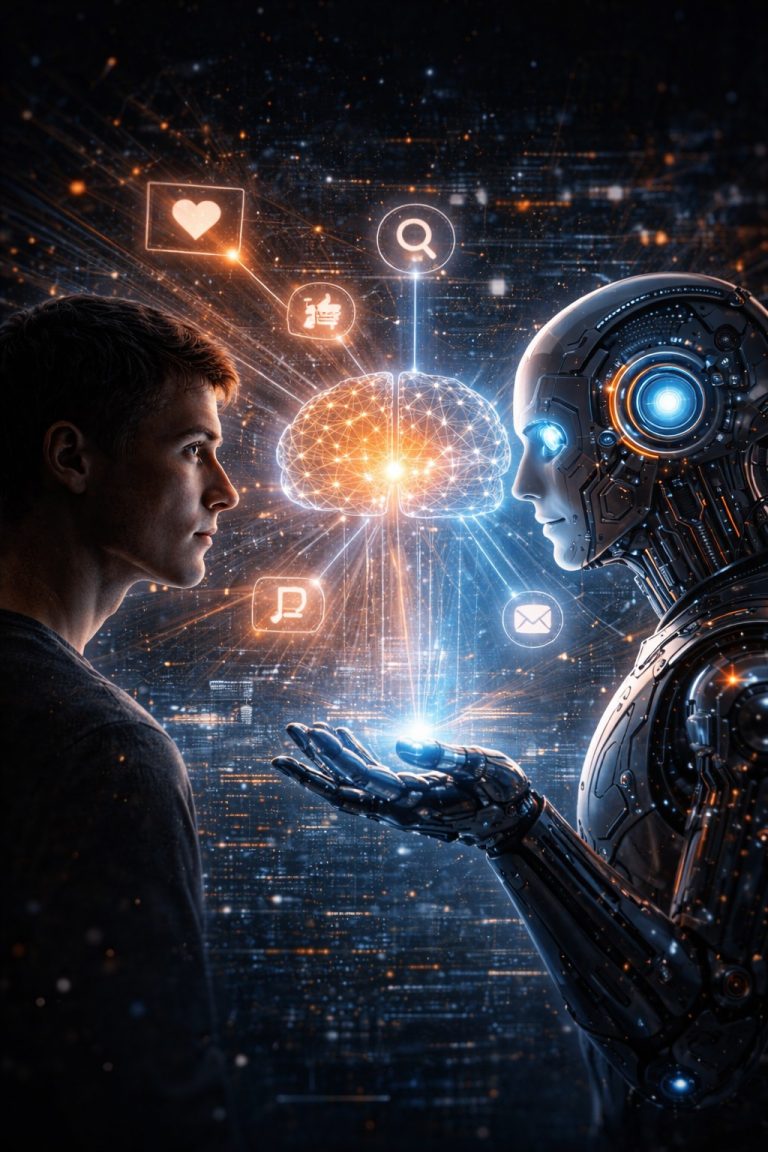

The Future of Choice: Will Intent Still Be Human?
Choice has long been understood as a defining feature of human agency. To choose is to express intention, preference, and identity. Yet as digital systems become more predictive, adaptive, and autonomous, the nature of choice itself is changing. Increasingly, decisions are anticipated before they are consciously made, and options are shaped before they are perceived. In this emerging landscape, intent is no longer formed solely within the individual mind. It is influenced, inferred, and sometimes guided by systems designed to optimize outcomes. The question is no longer whether technology affects choice, but whether intent will remain fundamentally human in a world where decisions are increasingly pre-shaped.
The Evolution of Choice in Technological Systems
Choice has never existed in a vacuum. Throughout history, tools and environments have shaped human decisions. What distinguishes the current moment is the scale and speed at which systems adapt to behavior.
Modern platforms do not merely present options; they learn from interaction and refine future possibilities. Choice evolves from selection to navigation within adaptive environments. What feels like freedom is increasingly experienced as smooth alignment between user and system.
This evolution changes not only how choices are made, but how intent is formed.
When Anticipation Replaces Deliberation
Anticipatory systems reduce the need for conscious decision-making. By predicting preferences, they present options that feel immediately relevant. Deliberation becomes unnecessary when the suggested path appears optimal.
This shift prioritizes convenience over reflection. While efficient, it narrows the space for reconsideration. Choice becomes acceptance rather than evaluation.
When anticipation replaces deliberation, intent risks becoming reactive rather than reflective.
Human Intent in a Predictive Environment
Human intent is shaped by uncertainty, contradiction, and change. People explore ideas, revise goals, and act against patterns. Predictive systems, however, are designed to minimize unpredictability.
As systems adapt, they reward consistency and discourage deviation. Over time, this dynamic stabilizes behavior, reinforcing existing preferences. Intent appears stable, but stability is partially imposed.
The tension between human variability and system optimization defines the future of intent.
The Role of Autonomy in Guided Choice
Autonomy does not disappear in guided environments, but it changes form. Instead of choosing among endless possibilities, individuals choose whether to accept guidance.
This meta-choice—whether to follow or question a suggestion—becomes central. Awareness determines autonomy more than option count.
In this sense, freedom shifts from selection to engagement.
Redefining Agency in the Age of Intelligent Systems
Agency has traditionally been associated with independence. In adaptive systems, agency may depend more on interaction quality than isolation.
Intent remains human when individuals understand how systems influence them and choose how to respond. Lack of awareness, not technology, erodes agency.
Agency evolves from resistance to discernment.
Can Intent Be Shared Between Humans and Machines?
The future may not be defined by a clear boundary between human and machine intent. Instead, intent may become co-constructed. Humans provide behavior; machines provide structure.
This shared intent is not inherently negative. It can enhance decision-making when aligned with human values. The challenge lies in ensuring transparency and accountability.
When systems reflect values rather than replace them, collaboration becomes possible.
Preserving Human Choice Through Awareness
Preserving human intent does not require rejecting predictive systems. It requires cultivating awareness. When individuals recognize how choices are shaped, they can reintroduce reflection.
Small acts—questioning defaults, seeking alternatives, slowing decisions—restore agency. Intent becomes a conscious process rather than an inferred outcome.
Awareness is the foundation of future choice.
RSOC Placement Opportunity (Optional Second Block)
(If implemented, ensure full viewport distance from the previous RSOC block and preserve editorial dominance.)
Conclusion: The Human Future of Intent
The future of choice will not be decided by machines alone. It will be shaped by how humans engage with intelligent systems.
Intent remains human when it is examined, questioned, and chosen with awareness. Technology may guide choices, but it does not define purpose.
In a world of prediction and optimization, the most human act may be conscious choice itself.